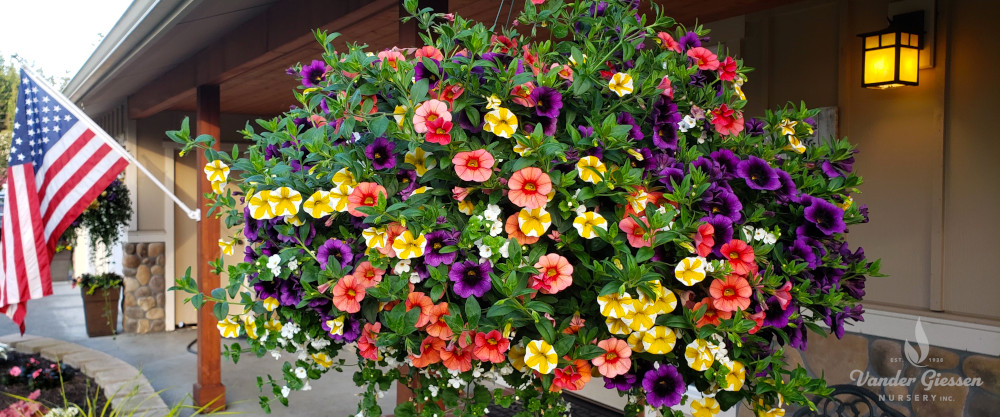
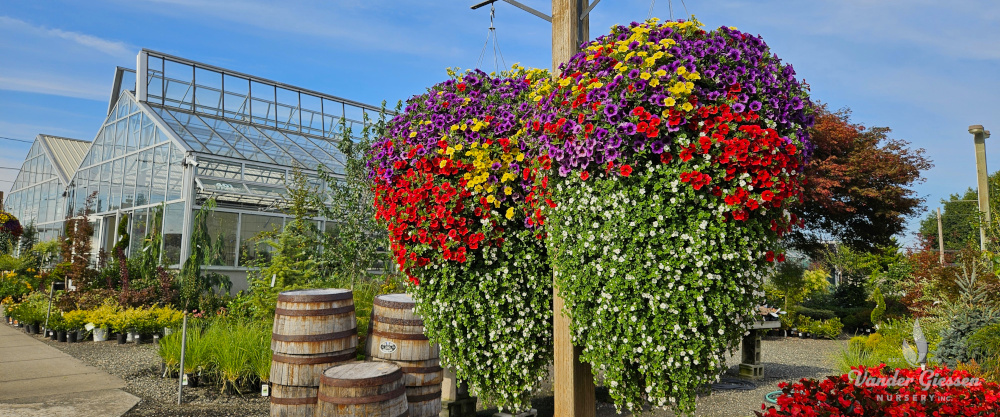
Hanging baskets–and in particular, our famous Lynden Baskets–are an easy way to add beautiful, long-lasting color to your front porch or back deck. And while caring for hanging baskets isn’t complicated, there are a few tips we like to share with our customers to ensure success in growing and caring for these beautiful plants. Follow the steps below and you’ll enjoy the beauty of our Lynden Baskets through summer and well into autumn–many of our customer leave theirs up until mid- to late October or beyond!
Watering
Water your hanging baskets every day until the water begins to run out the bottom of the baskets. Because we use a well-drained potting mix when planting, it’s almost impossible to overwater your baskets.
On hot days–any day with temperatures over 80 degrees F–water twice daily, especially for smaller 12″ baskets. Large 16″ and 18″ baskets have more than twice the amount of soil as a 12″, so you may be able to get by with a single watering on larger baskets, but see above–it’s almost impossible to overwater your baskets, so if you’re unsure, err on the side of too much water when the weather is warm.
Fertilizing
Feeding your plants is not optional–just like humans, hanging baskets need regular, nutrient-rich food to thrive. The only fertilizer we trust–and the only one we use ourselves–is Jack’s Classic water-soluble plant food. This professional-grade plant food is unrivaled in quality and delivers where it matters most: the results.
For the best results, feed your baskets once a week, alternating between Jack’s Classic All-Purpose for plant growth and Jack’s Classic Blossom Booster for flowering. Because we feed our baskets with Jack’s at the nursery at a constant, low dose rate, you can begin feeding your baskets anytime within a week of taking them home from the nursery. Pick up tubs of Jack’s Classic at the nursery year-round; because we are such believers in the results it delivers, we always have it in stock!
Deadheading
Thanks to modern plant breeding advancements, the vast majority of the plants we use in our hanging baskets need no deadheading at all in order to continue looking beautiful. When we tell our customers our baskets are no-fuss, we mean it. The only plants we use in any of the baskets that should be deadheaded regularly are Calliope geraniums, used in some of our mixed sun-loving Lynden Baskets. All other plants used in our mixes are self-deadheading, meaning the flowers fall off on their own and do not need to be pinched or trimmed to continue blooming.
Insect Control
As much as you love your hanging baskets, at some point, bugs will likely fall in love with them too. The two main insects to watch your hanging baskets for are aphids and budworms. Aphids show up as small green, brown, or black bugs clustered around flower buds or at the growing tips of branches, where they suck the sap out of plant tissues. To treat for aphids, we recommend spraying with BioAdvanced Insect, Disease, & Plant Mite Control or Bonide NeemMax, both effective, easy-to-use sprays that quickly kill aphids. Watch for aphids to show up beginning in June, and spray as needed throughout the season.
Budworms typically show up beginning in late June or early July, and can be identified as small green or brown caterpillars that come out in the overnight hours to chew on flowers and buds. Although budworms rarely damage plant foliage, they can quickly decimate the blooms of a once-colorful hanging basket, so they should be kept in check. We highly recommend spraying for budworms with Captain Jack’s Deadbug Brew, an organic insecticide made from bacteria discovered in an abandoned rum factory in the Caribbean that’s proven deadly to caterpillars and many other garden pests. Spray Deadbug Brew at dusk for best results, as the bacteria breaks down in bright daytime sun, and to make the best contact with caterpillars coming out to feed.

Leave A Comment