
Although not explicitly a Christmas song, “My Favorite Things” from The Sound of Music has long been associated with Christmas, regularly playing on radio during the holiday season. Truth be told, for us gardeners, the spring season holds more than a few of our favorite things never mentioned in the classic song. As we enjoy a gloriously sunny break from the wet weather that dominated March, here are a few of my favorite things I’ll be enjoying in the garden this spring.
First on my list: fresh berries. Although it will be a couple of months before we can enjoy the abundance of fruit that strawberries, raspberries, and blueberries provide, now is the perfect time to plant for a summer harvest. Nothing beats the feeling of biting into a juicy, sweet strawberry on a warm early summer evening—and blueberries and raspberries are equally rewarding.
Whether you’re wanting to plant a long row of berry bushes in a sprawling garden or have only a small patio or deck to place a couple of pots, berry plants come in a wide range of sizes well-suited for both in-ground planting or container growing. For a great blueberry variety you can grow in a container, check out ‘Peach Sorbet,’ a dwarf variety that only grows to two feet tall and is self-pollinating, making it a great stand-alone variety. With peach-hued new growth in spring that ages to a rich dark green in summer, Peach Sorbet holds its foliage in winter, turning a rich purple. This variety produces loads of medium-sized berries that are known for their sweetness and tropical flavor.
If you already have berries in your garden or containers, now is also the time to feed them—after all, you want loads of berries this summer, so your plants need the nutrients to produce an abundant harvest. Whether your berries are newly planted or have been in the ground for years, feed now with Espoma Berry-Tone, an organic fertilizer with the right blend of nutrients to encourage fruiting. Feed blueberries and raspberries a second time in late May or early June to encourage growth for the following year.
Second on my list of favorite things this spring is color for the landscape. Winter can be such a gray time of year in the garden, but come spring, the yard bursts back to life and I’m reminded again why I love gardening so much. Of course, summer annuals add unbeatable color to flowerbeds, containers, and hanging baskets, but while we wait for warm enough weather to plant our summer flowers, there are plenty of hardy shrubs and perennials to enjoy for their color, too.
For spring color that lasts for months, one shrub that’s hard to beat is pieris. In late winter, drooping clusters of flowers open from buds that formed the autumn prior, revealing beautiful white or pink blooms that last for weeks. After blooming, the new growth on pieris emerges, and for varieties like ‘Forest Flame’, the new growth is its own show, with flaming-red leaves that slowly transition to orange, yellow, and eventually green. Forest Flame grows to six to eight feet tall and about as wide, but can be kept smaller with pruning—or, as an alternative, ‘Prelude’ and ‘Little Heath’ offer their own beautiful evergreen color in a smaller, more compact alternative.
Another must-have for any Pacific Northwest garden is our state flower, the rhododendron. As with so many landscape shrubs once considered boring, rhododendrons today come in a wide range of eye-catching colors and in compact forms that won’t overtake a garden. ‘Seaview Sunset’ offers hues of orange, peach and yellow that evoke an evening on a tropical beach, and ‘Pomegranate Splash’ has unique two-toned blooms of white edged with rich pomegranate-pink shades. These along with so many other unique colors make rhododendrons worthy of a spot in your garden.
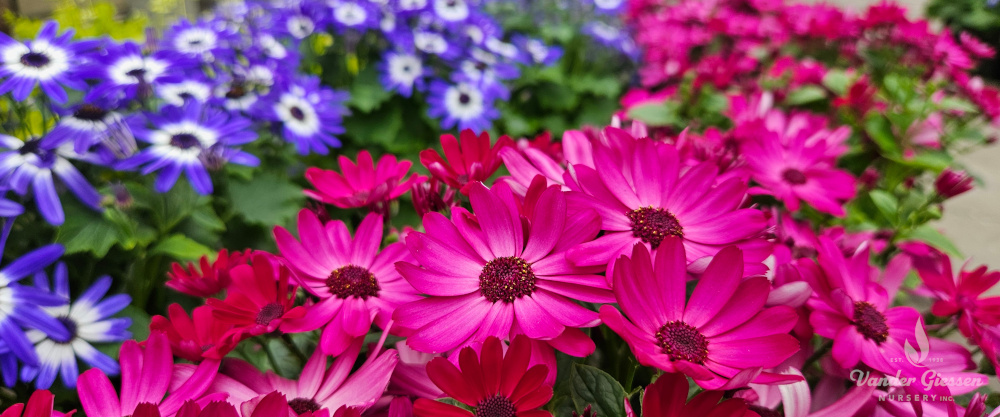
Finally, one of my all-time favorite flowers for spring—and one still underappreciated among gardeners, in my opinion—is the Senetti daisy, or cineraria. While pansies and primroses get the spotlight early in the season and petunias, begonias, and a host of other flowers dominate the late spring and summer season, Senettis deserve a place in your spring container gardens.
With shades of pink and purple so saturated they almost hurt the eye, Senettis are absolutely stunning, and since they produce so many blooms—as many as two hundred at a time on a single plant—they’re sure to catch the eye of even the most distracted passerby. Deadhead these annuals regularly to keep them in bloom all summer or shear and feed after blooming to encourage a new wave of flowers throughout the summer.
No matter what’s on your list of favorite things to enjoy in the garden, I think we can all agree on one thing: “raindrops on roses” was hardly enough mention in the famous song to justify the joy that gardening brings to those of us who enjoy getting our hands in the dirt. But I’ll leave the songwriting to the likes of Rodgers and Hammerstein—for me, I’d rather be in the garden.
Leave A Comment