
The roar of jets at the Abbotsford Airshow and the bustle of activity on Front Street in Lynden getting ready for the Northwest Washington Fair can mean only one thing: summer is quickly drawing to a close. Just because fall is just around the corner, though, doesn’t mean that summer’s beauty is ending; in fact, some of the biggest and brightest stars of summer in the garden are just taking the stage. Here are a few of my favorite late-summer standouts and tips to maximize the beauty and abundance of your garden stars this month.
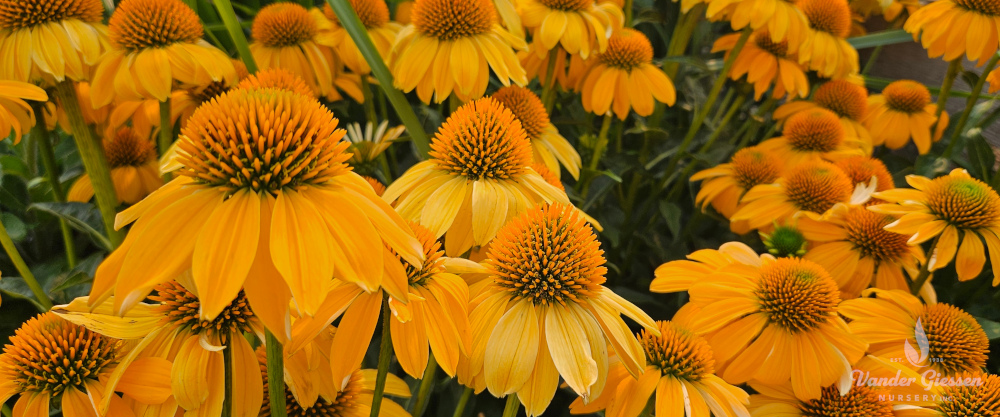
First, late summer is when a couple of my favorite perennials really put on their show. Echinacea—commonly known as coneflower—is a must-have for sunny garden spaces. With shades in just about every color of the rainbow, echinacea bloom from late June or early July through September, adding pollinator-attracting blooms to the garden to bridge the shift in seasons from summer to fall.
In the last number of years, plant breeders have introduced some incredible varieties of echinacea, and some of my favorites are in the Sombrero series. Compact and hardy, Sombrero echinacea come back reliably each year given that they’re planted in well-drained soil. Check out Granada Gold, with rich, butter-yellow flowers, or Sangrita, which shines with fiery red-orange blooms.
My second must-have perennial for late summer color is perennial hibiscus—truly the queen of the late-summer garden. Related to both tropical hibiscus and the Rose of Sharon shrub hibiscus, perennial hibiscus boasts flowers much larger than either of its cousins, with huge eight- to nine-inch blooms from mid-August through late September.
Available in shades of red, pink, and white, perennial hibiscus can put out hundreds of blooms in a season, so they’re well worth a spot in a sunny garden. Two of my favorite varieties are Cookies and Cream, with pure white blooms set against near-black foliage (a perfect plant for gardeners who love white-themed gardens), and Garnet Globes, a new compact variety with slightly ruffled blood-red flowers and deep green foliage.
Although the blooms of perennial hibiscus look like the plant shouldn’t be hardy for our winter northeasters, this type survives temperatures down to -20 degrees Fahrenheit, making them well-suited for climates even much colder than our area, so plant confidently in full sun and enjoy their giant blooms year after year.
Third, in the world of cut flowers, dahlias are the star of the show in late summer—and for good reason. With thousands of varieties, dahlias come in every shape, size, color and texture. If you’re relatively new to growing dahlias, one of the best things you can do throughout the summer is to cut deep when harvesting blooms. See a bloom you want to pick? Make your cut 12-18 inches down the stem, even if it means removing side buds that haven’t bloomed yet. Cutting deep produces sturdier plants and encourages longer stems for your flowers, making harvesting and displaying your flowers in a vase easier as the season progresses.
Fourth, if you’re growing a vegetable garden, you’re almost certainly growing tomatoes—and here in the Pacific Northwest, late summer and early fall is when these stars of the vegetable garden finally reward your growing efforts with juicy, sweet fruit. Although we’ve had some hot weather this summer, for whatever reason I’ve heard from a number of gardeners that their tomatoes seem to be ripening later than normal.
If you have tomato plants that have set fruit but you’re eager to get them to ripen faster, now is the time to start thinning out and cutting back the extra foliage. Removing some of the leaves, side branches, and even undersized fruit in late summer will force your tomato plants to direct their energy to sizing up and ripening the larger fruit that’s already developing, giving you a good harvest before autumn’s cooler weather arrives.
Additionally, if you haven’t been feeding your tomatoes with a high potassium fertilizer, now is the time to start. Vegetable fertilizers like Jack’s Veggie Feed have extra potassium, which plays a key role in moving sugars and starches within tomato plants, helping the fruit grow larger and sweeter for a tasty, juicy crop.
Last, no show on the stage or in the garden would be complete without an antagonist—that villain that tries to ruin the story. Maybe it’s just me, but August seems to be the time of year when my nemeses—the neighborhood moles—really start to get active after laying low for the early summer months. To fend off mole damage in your yard, I recommend treating your lawn with Bonide Eight granules, an insecticide targeted to kill the grubs that damage your lawn and attract moles in search of a tasty morsel. Apply Eight in August or early September and you’ll discourage mole activity in your lawn or garden as well as kill off the cranefly larvae that could otherwise kill off portions of your lawn over the fall and winter months.
Soon enough, the curtain will fall on summer and rise to begin a new season. For now, though, let’s enjoy the stars of late summer in the garden and make the most of these fleeting days.


Leave A Comment